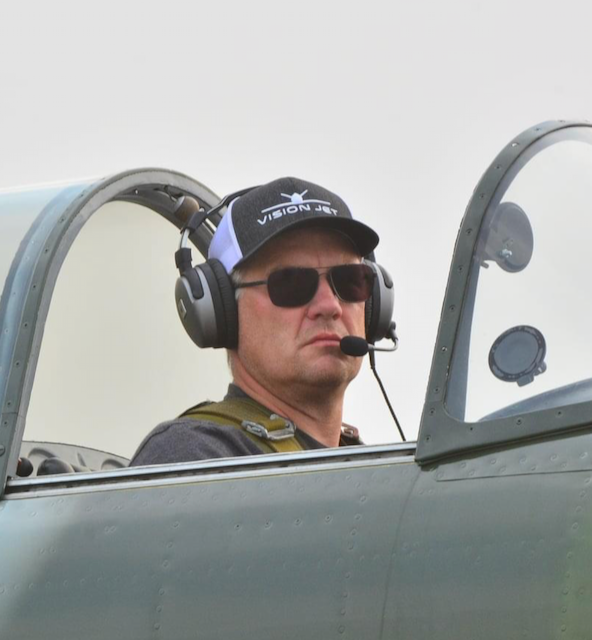
I’ve done enough reading, studying, and learning to understand the basics of how anxiety works. I’ve lived with it and learned to accept and embrace it – mostly. And at it’s core, anxiety is there to help us survive, it’s a gift we all carry in various amounts and levels that’s enabled the human race to by and large avoid disaster and stay alive. Without it, many of us would have long met our demise – without it we might not have jumped out of the way of that sabre-toothed tiger lurching toward us, or perhaps we might have run across the street without looking, or worse yet, jumped out of a perfectly good airplane (there are no good reasons). Anxiety in one way or another is our searchlight that is continually on the lookout for something that will harm us. For some of us, its just using a slightly brighter light and putting in some overtime. If you want to know more about my journey to learn how to handle anxiety and OCD, I can talk more. I’d gladly take up the conversation privately, and may do so more publicly some day as well. I think I could write a book on that one alone.
But what I want to share about is something a bit more nuanced than straight up mental health. It’s another journey I’ve been on for a while now and puts some of the same skills to work. It’s one of the root causes of what gets our anxiety going, and the more I look at it the more I see it in action all over the place – in our homes, families, relationships and workplaces. It’s what I call the Gap of Uncertainty.
Here’s the thing. Every which way we turn we will encounter gaps in information. This is especially true in all of the interactions we have with human beings – from “Why has it been 3 days since our first date and she still hasn’t called me?” to “Why did her dad hesitate when I asked if I could marry his daughter?”. Both gaps leave us in a spot where we lack information, and have a choice between two things: Trust or Suspicion.
In a world where information flows in amounts and speeds exponential to previous generations, we are constantly faced with gaps in uncertainty. Our brains search incessantly for these gaps, and are at the ready to try and fill them. More often than not, it’s with suspicion. The human brain’s ability to jump to conclusions is spectacular.
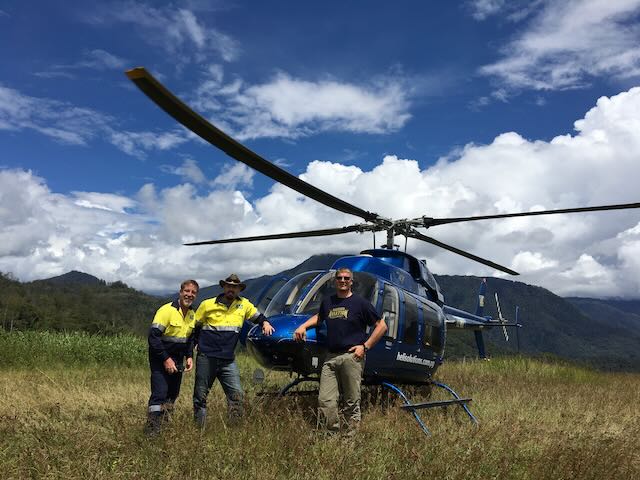
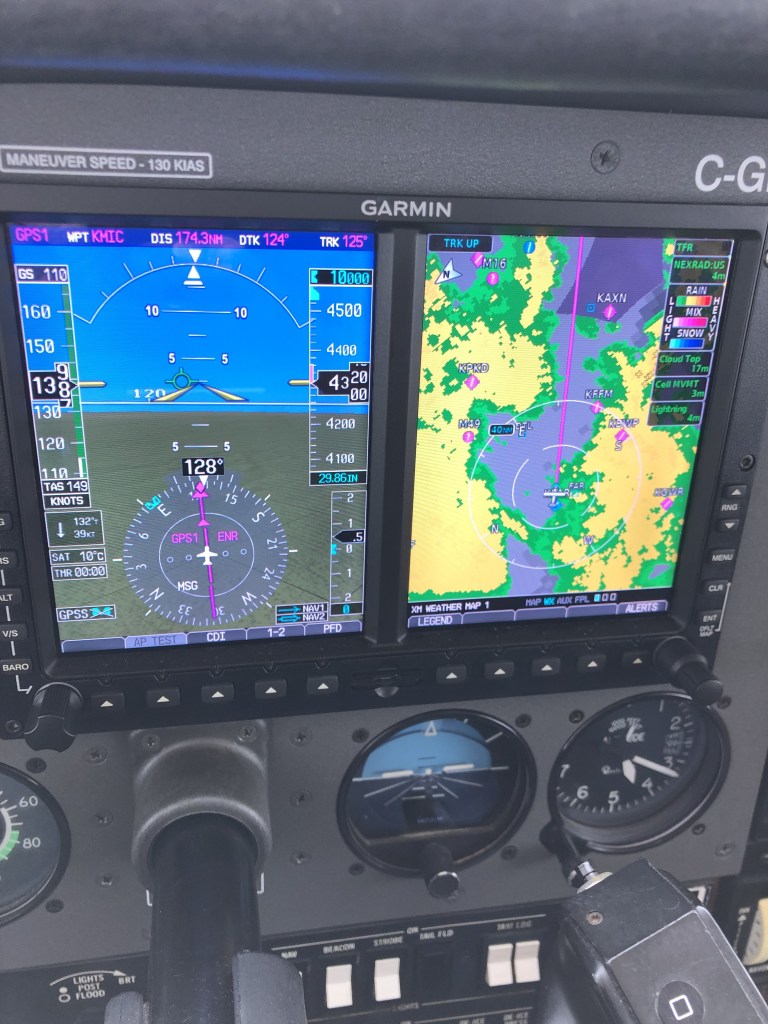
In 2014, I set out to obtain my Instrument Rating. For those not fully familiar with the aviation world, there are basically two ways to fly an airplane: Under Visual Flight Rules (VFR), where the pilot can see the ground, and under Instrument Flight Rules (IFR), where the pilot cannot see the ground, nor likely anything else out the window. An instrument rating, coupled with an instrument equipped aircraft, allows the pilot to fly the airplane from within seconds of takeoff, to within seconds of landing, without seeing the ground. I didn’t really know what I was getting into in trying to get this rating, but it completely changed me. It’s a way of flying that opens up the world in all kinds of weather, and makes it remarkably safer while doing so. It requires extensive training, almost like learning a new language. It forces you to be on your game, and to be disciplined (which I naturally am not). I absolutely love the technical aspects of instrument flying, and the reward of going from place to place by only trusting your instruments. Flying on instruments is like living life by facts, and that’s how I began to look at gaps of uncertainty.
Early on in the process to become an instrument rated pilot, I had to first learn how to overcome spacial disorientation and vertigo. Much of our sense of well-being and balance comes from visual references our eyes get, which then turn into signals our brain receives. When we lose visual reference to a horizon, vertigo or motion sickness can set in. One of the first steps in training is to put on a vision restricting device, or a “hood”, which prevents you from seeing anything but the instruments of the airplane. No visual reference to the horizon.
One of the experiences that drove me to explore training for an instrument rating was in 2012. I had recently become recertified to fly medically, and I needed to take a business trip to Swift Current. While we were visiting a customer, the weather deteriorated, with low ceilings, poor visibility, and freezing fog on top of a white wilderness. We were grounded, and spent the better part of 3 days between Tim Hortons and the walls of a Super 8 Motel in the middle of Tim-buk-chuk Saskatchewan in winter. Boredom is an understatement. As is typical of pilots, and often makes statistics out of them, “get-home-itis” set in. The clouds lifted ever so slightly, and I decided it was time to head home. This was not a good decision.
We got about 40 miles out of Swift Current, and I was flying just under the whisps of a stratus layer and barely 800′ over the ground. I was doing what is affectionately known among pilots as “scud running”. It’s dangerous – you barely get clearance over radio towers, if you can see them, and in the case of engine problems you don’t have altitude to trade for time to think. But I did not want to sit one more day in that Tim Hortons, so I made a bad decision to make the flight.
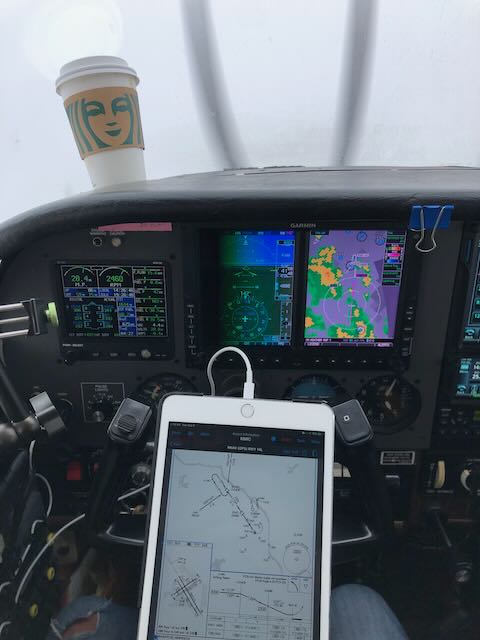
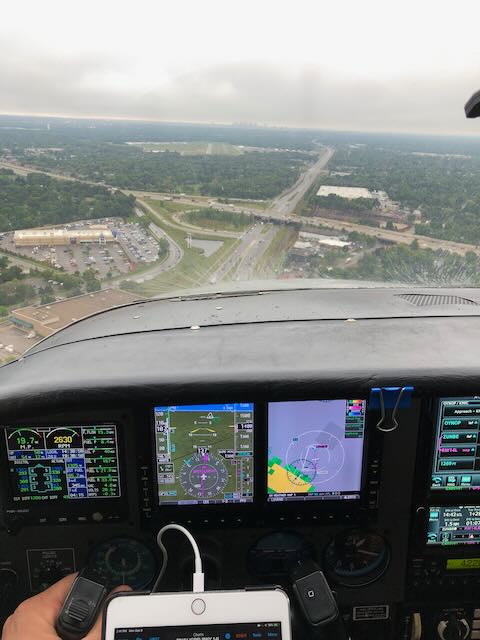
On the horizon, I started to notice a bit of a darker line. I was in a bad spot, but there was something ahead, and I began to rationalize what it could be. Somehow I made myself believe it was an opening in the clouds, where the sun was shining down to the earth, where we could climb up and be on our way. I told my unsuspecting passenger as much! But my meteorology skills at that point were based on hope, and they were desperately wrong – they blue line was where the low ceiling was meeting up with a fog layer, and we flew straight into it. I was now in a really, really bad place – I had flown VFR into IMC (Instrument Meteorological Conditions). In plain language, I was flying completely blind, barely over the ground, with an unaware passenger. According to statistics, we had 178 seconds to live. That’s the average amount of time a VFR pilot can stay alive when they do what I did.
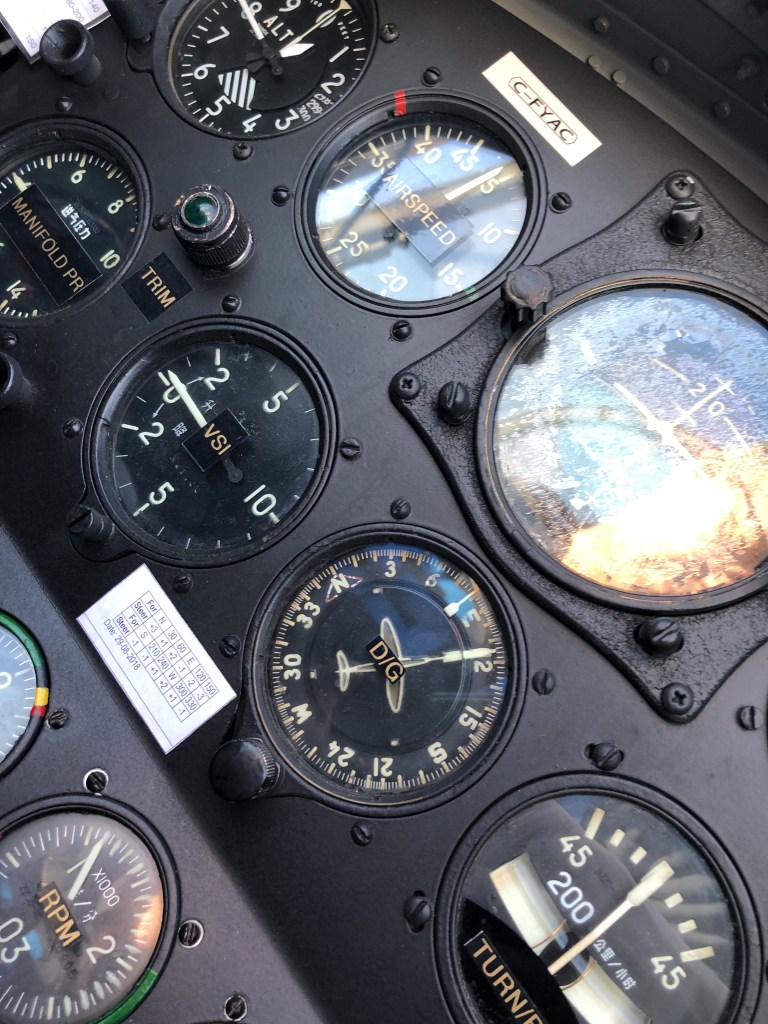
I hadn’t done any real instrument training at that point, but I had looked into it a bit. As a very basic requirement, any private pilot is required to do some minimal amount of instrument training. But it’s more or less enough to expose you to some concepts, not prepare you for the real thing. Yet, the one thing that stuck in my mind from this minimal amount of training and reading I had done was the old adage, “trust your instruments”. As we barreled straight into the cloud, my senses lit on fire. My eyesight pinned, and I was in full panic. But I remembered, trust your instruments. I knew we were low, so the first thing was to gain altitude. I put he airplane in a climb. This would just make the whole seeing the ground thing worse, and I knew that. I had to do something else. At about this point, vertigo started to set in. It’s hard to describe, but for me it’s the feeling of the world spinning around. I made the airplane feel like it was going straight and level and that felt better – but then I looked at my instruments. My artificial horizon was cranked over about 60 degrees. Airspeed was rapidly increasing. I couldn’t compute this – my brain and body felt like we were straight and level, cruising nicely. But my instruments were telling me something wildly different – we were in a death spiral.

Trust your instruments. Those are the words God gave to me at that moment in time. So I did it. I twisted the yoke to level the horizon, and it felt like it took all my strength to do it. I pulled up to level out of the dive. It took everything I had to do those two things, and my brain was screaming at me that we were spiraling out of control. Except now we weren’t. I gathered myself, and just kept repeating in my head, maybe even out loud, trust your instruments. Now I had to get my self out of this mess. I knew that where we came from wasn’t great, but at least we could see when below the clouds. I forced myself to make a 180 degree turn back to where we left. I was quite disoriented, and barely navigating. I knew I needed help, so I called up Moose Jaw and declared an emergency. They got my call sign and some basic info before I lost radio contact, I was just a little too far out. Still fighting my internal forces, I continued back the way we had come, and descended to the altitude we had been, knowing that would be fairly safe. Finally after a few minutes, I saw the dark line of a tree row flash by beneath. I knew we were almost out of the cloud, a little more descent and the ground became clear. I had no idea at that point how close I had been to dying in a ball of crumpled aluminum on a Saskatchewan wheat field in the dead of winter.
A week later, I got a call from Transport Canada. The officer was checking up on the file, and since I had declared an emergency he needed to resolve the case to close it off. It hit me square between the eyes when he told me that he very rarely, if ever, got to make this call. Normally when this happens he’s calling someone’s next of kin.
Trusting our instruments isn’t natural. It takes a lot of effort. And I still get it wrong all the time. My brain wants to interpret gaps in information constantly. Whether it’s a tardy reply to an email, a short curt text, a funny look, or a hesitation. One of the repeat offenders for me is when an employee asks “do you have time to meet?”. Yeah, my brain runs completely and wildly out of control on that one. It’s hard, it can be exhausting, but trusting our instruments – intentionally choosing trust over suspicion – more often than not proves to be the right thing to do.
My approach lately has been to just take a bit of step back and observe. Just notice how this makes itself known in others. It becomes easier all the time to see it in action, watching and listening to how other people will typically default to suspicion instead of trust when they are presented with a gap in information. I’ve found that after practicing this for a while, it’s becoming ever so slightly easier to see it in myself. It’s still hard to make the switch, but it’s becoming easier to identify and then make that choice. I find it a lot like turning the yoke to level the airplane when my brain is screaming at me but my instruments are telling me something different. It takes all I have sometimes.
Choosing trust over suspicion is likely a skill a lot like instrument flying – you need to keep using it in order to not be losing it. I’m planning to keep practicing both for a long time.

 Chris’s Blog
I really enjoy reading up your adventures Chris ! Inspires me to keep on learning about flying and challenge myself. Since I only have my rec I’m trying to upgrade to private and hope for more adventures. Hope you’re doing well and again enjoy the stories.
LikeLike
Morning Chris,
Thank You for sharing your story! Reading stories like the one you just shared inspires me to continually improve my skills.
LikeLike
Thanks for shareing your expriecene Chris ,i remember getting caught in a snow squal and had a white out, that was not good. Wishing you and your family all the best.
LikeLike